In South Florida, our water is our life. When you notice something “off” about the water, whether its the intracoastal, your community lake, or the New River running through your backyard, it’s important to act quickly. The first step to protecting our waterways is knowing exactly what you are looking at, because in our ecosystems, looks can be deceiving.
The “Stick Test” — Oil vs. Bacteria
It can be tricky to figure out if you are looking at a pollutant or a natural biological process. Sometimes certain iron-eating bacterial create a “bio-sheen” that looks remarkably like a motor oil or gasoline spill.
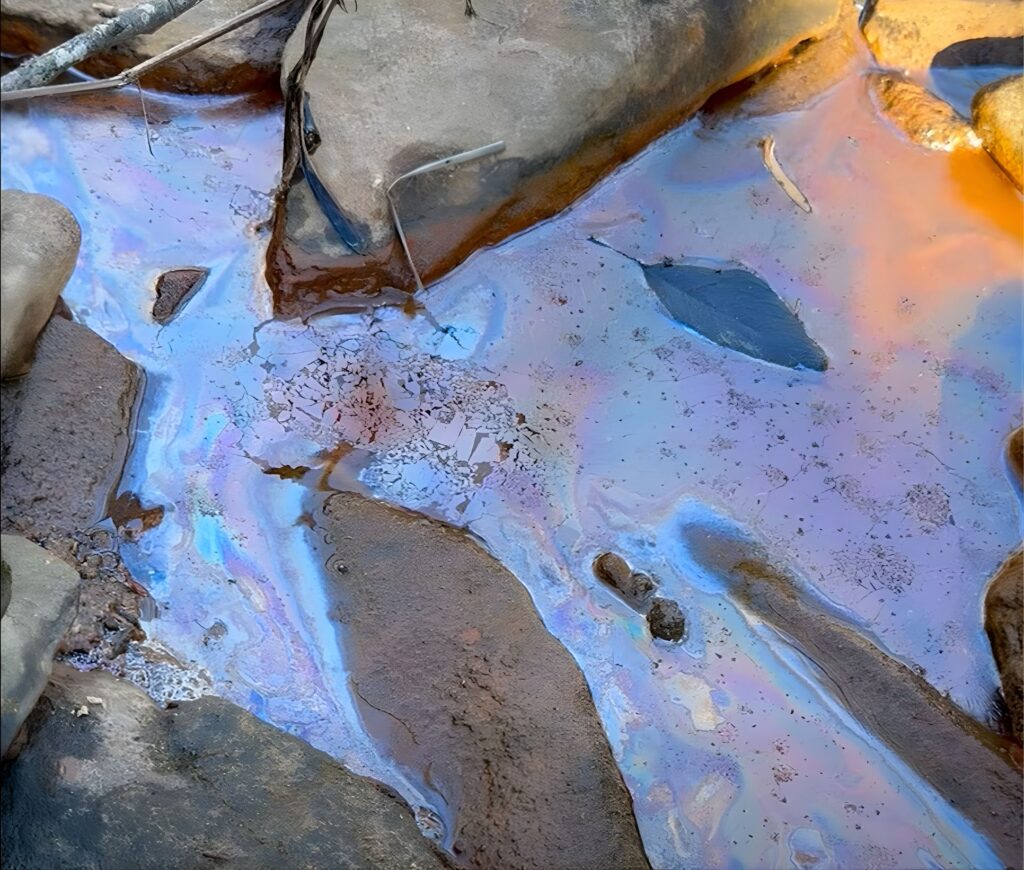
All you need to help assess the situation is a stick. Find a long stick or a palm frond and gently poke the center of the sheen. Watch closely how the surface reacts:
- If it’s Petroleum: Oil and gas are fluid and elastic. When you poke the sheen, it will typically swirl and flow around the stick. Once you pull the stick away, the colors will quickly “self-heal” and reform into a solid, shimmering sheet. Sometimes you will also notice a chemical or fuel smell.
- If it’s Bacteria: Natural bacterial sheens are brittle. When you poke them, they won’t swirl, they will shatter. The sheen will break into sharp, jagged “plates” or blocks, like a mirror or a thin sheet of ice. These pieces will stay separated and won’t flow back together. Click here to see what that could look like.
The Rule of Thumb: If it shatters like glass, it is more likely to be natural. If it swirls and stays together, it’s typically a pollutant. The “Stick Test” is simply a tool and does not guarantee any result. Always go with your gut and play it safe.
Who to Call
- Local Response: 911
- If the spill is active, large, or poses an immediate threat to life and safety, call 911 immediately. The local 911 Center will determine what local officials need to respond. This may include fire/rescue, HazMat, marine patrol operations, law enforcement, and other officials.
- State Oversight/Investigation: The State Watch Office, 1-800-320-0519
- The State Watch Office is a “situational awareness hub” and for this type of environmental hazard, they may notify the Florida Department of Environmental Protection (FDEP), the Florida Fish and Wildlife Conservation Commission (FWC), the Coast Guard, and the local Emergency Management Division.
What to Say
- LOCATION
- Street Address: The nearest physical address or intersection.
- GPS Coordinates: Open your Maps app on your phone, drop a pin, and read the Latitude/Longitude.
- Landmarks: “North of the 17th Street Bridge” or “Next to dock number 32.”
- DESCRIPTION
- Color: Is it rainbow (sheen), milky white, opaque black, or fluorescent green?
- Consistency: Is it a thin film, thick sludge, “curdled” (often wastewater), or bubbling?
- Odor: Does it smell like rotten eggs (sulfur/sewage), gasoline, or is it odorless?
- Extent: Estimate the size. “It’s about 10 feet wide and stretching 50 feet down the seawall.”
- Impact: Are wildlife impacted? Are manatees observed within or near the spill? Is oil coating the mangrove roots?
- SOURCE & MOVEMENT
- Source: Can you see where it’s coming from? A specific pipe, a sinking boat, or a runoff from a construction site?
- Direction: “It is moving east toward the Intracoastal,” or “It is being sucked into the storm drain.”
- Current State: Is it an “active discharge” (still flowing) or a “stationary patch?”
- Tide: Note if the tide is incoming or outgoing. This can help responders determine where the spill may move.
Documentation
- Photos & Video: If safe and practical, capture the pollution incident, the source, and any impacts.
- Keep a Log: Note the date/time of the observation, who you notified and spoke with, report numbers, and the outcome.
Follow-Up
Need to escalate your report or check on its status? The following are direct lines for South Florida’s environmental protection agencies.
- Florida Department of Environmental Protection, Southeast District Office
- Main: 561-681-6600
- 24-Hour Emergency Line: 1-800-320-0519
- Miami-Dade Department of Environmental Resources Management
- Main: 305-372-6789
- 24-Hour Emergency Line: 305-372-6955
- Broward County Resilient Environment Department
- Main: 954-831-4000
- After-Hours Complaint Line: 954-519-1499
- Florida Fish and Wildlife Conservation Commission, South Regional Office
- Main: 561-625-5122
- 24-Hour Emergency Line: 1-888-404-3922
Help us track environmental incidents occurring in South Florida! Reach out to notify us of an incident or ask for our help. (If there is an immediate threat to life, health, or safety, call 911.)